
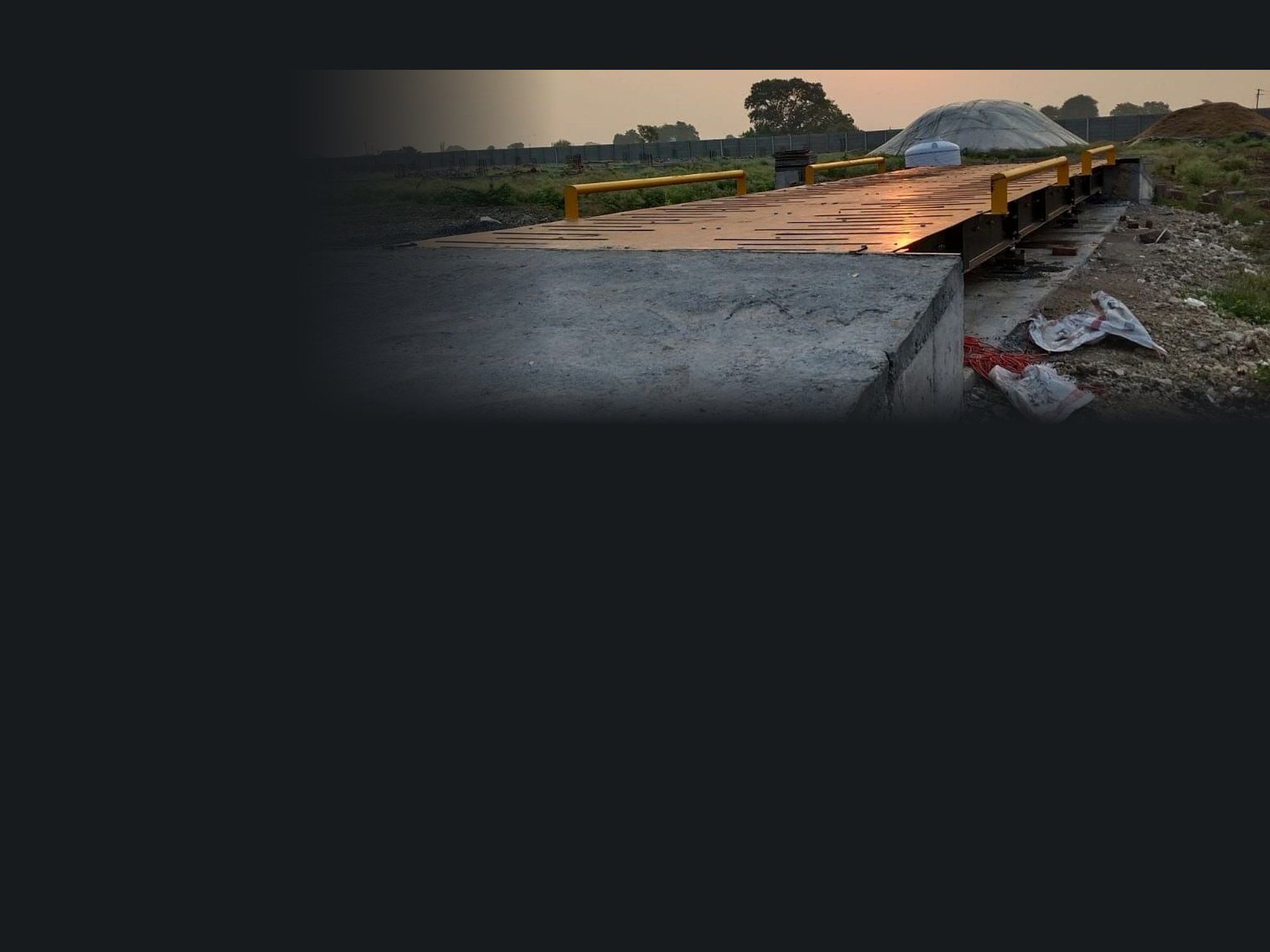
Khargone weighbridges for kapas trolleys, bale trucks and Bedia chilli.
Khargone, the district seat of Nimar in south-west Madhya Pradesh, is black-soil cotton and chilli country in the Narmada valley, where cotton is the money crop and red chilli the famous one. From October the kapas trolleys reach the Khargone mandi and the ginning and pressing units of Sanawad, Kasrawad and Bhikangaon; from January the dried chilli of the region moves through the Bedia mandi in bags. Maize, soybean and wheat fill the rest of the year, and the oil mills, cattle-feed makers and stockists of the district keep lorries on the same roads. Symphony supplies weighbridges, truck scales and dharam kanta (धर्म कांटा / tol kanta) across Khargone district.
A Khargone ginning and pressing unit usually settles on 60 MT and 16 m in pit-less steel, so a tractor with a high trolley of kapas, or a bale truck, stands whole on the platform; a Bedia chilli trader fits 40 MT on 12 m with a slip for every lot; a maize or soybean buyer 50 MT on 14 m; and a public weighbridge or building-material yard 80–100 MT on 16–18 m in concrete (RCC) or heavy pit-less steel. The steel is made in Ahmedabad and is ready to dispatch about 2 weeks after a commercially cleared order with PO, in good time for the footings to cure.
Gross at the gate, tare after unloading: one slip the farmer and the factory both trust.
- A fresh empty weight for each trolleyA platform for tractor and trolley together, a new tare after unloading and a slip both sides can read.
- Intake and dispatch kept apartSMFW records kapas in and bales and cottonseed out, by party and vehicle, with a remarks field for notes such as moisture.
- A clean reading for each chilli lotA pit-less build with an open underside that is easy to sweep, verified for trade.
Who needs one in Khargone: Cotton ginning and pressing factories and cottonseed crushers; kapas buyers and commission agents at the Khargone, Sanawad and Bhikangaon mandis; red-chilli traders, dryers and stockists at Bedia (Bediya); maize, soybean, wheat and gram traders; cattle-feed and oil-mill operators; aggregate, sand and building-material suppliers; fertiliser and seed stockists; goods transporters; and public dharam kanta operators on the district's highways.
Also called a dharam kanta (धर्म कांटा), truck scale or weigh bridge. We also serve Sanawad, Barwah, Kasrawad, Maheshwar, Mandleshwar, Bhikangaon, Bedia.
Ginners, chilli traders, grain buyers and contractors across Khargone district.
Ginning and pressing factories
Kapas trolleys arrive day and night in season, each with its own tare and moisture, while bales and cottonseed leave in the same weeks.
Our setup: A 60 MT, 16 m pit-less weighbridge, a fresh empty weight each trip and separate SMFW intake and dispatch records.
Chilli traders and stockists
Chilli lots are light but valuable, the buyer wants a slip for each, and dry chilli dust settles in every gap.
Our setup: A 40 MT, 12 m stamped pit-less weighbridge that is easy to sweep, with a closed cabin and a slip for every lot.
Aggregate, sand and building-material yards
Tippers and tractor-tippers are paid by the trip, and the buyer asks for the weight in writing.
Our setup: An 80 MT, 16 m concrete (RCC) or heavy pit-less weighbridge with sealed IP68/IP69K cells and a printed slip per trip.
Maize, soybean and wheat buyers
Trucks and trolleys of grain queue at the mandi gate in the harvest weeks, and every seller expects a slip on the spot.
Our setup: A stamped 50 MT, 14 m pit-less weighbridge on pedestals, party-wise SMFW slips and a display turned to the unloading bay.
- Khargone krishi upaj mandikapas, maize, soybean and wheat arrivals
- Bedia mandidried red chilli and the godowns around it
- Sanawadginning factories, cottonseed crushers and traders
- Kasrawadkapas buyers, ginners and grain traders
- Bhikangaonginning and pressing units and farm-input shops
Black soil, high trolleys and chilli dust: where a Khargone weighbridge should go.
Cotton and chilli are weighed in very different ways, and a Khargone weighbridge has to serve both. Kapas is light and bulky: farmers pile it high on tractor-trolleys, so the platform must take tractor and trolley together, and because trolleys differ, a fresh empty weight is taken after unloading each time. The factory pays for what it weighed, but it earns on lint, so the slip with gross, tare and net should be agreed with the farmer at the gate, with the moisture reading noted beside it. Pressed bales leave on trucks, a standard bale being about 170 kg, and cottonseed goes to the crushers in the same weeks, so SMFW keeps intake and dispatch as separate records. At the peak the gate runs round the clock, and an indicator the operator can read at a glance, a printer that does not run dry and an approach wide enough to park trolleys off the road decide how fast the queue moves. Chilli at Bedia is another story. Lots are light and valuable, the buyer wants a slip for each, and dry chilli dust gets into every gap and irritates the eyes, so a pit-less platform with an open underside is easier to sweep and a closed, cleanable cabin keeps the operator comfortable. A stockist or godown weighs chilli in at harvest and out through the year, which doubles the use of the same platform. Maize and soybean traders fit a mid-size platform, and the contractors who supply aggregate and sand need a heavier one, 80–100 MT in concrete (RCC) or heavy pit-less steel. Nimar's black soil swells in the rains and cracks in the heat, so the foundation drawing sets the footing depth, down to firm ground or onto a compacted base, and the civil work follows it. Summer here passes 45°C, so the indicator and cabin electronics are specified for it, with a UPS and good earthing for the storm season. Plan the foundation to be complete by September, ahead of the October kapas season, and book dispatch about 2 weeks before it is needed. A season has three phases at a Khargone gate. In the early weeks only a few trolleys come and the staff learn the routine. Then the peak arrives, and a trolley is on and off the platform in under a minute if the operator, the printer and the farmer's receipt work together; for that, the display should face the unloading bay so the farmer sees the number he is paid on. In the tail of the season bales and seed go out in volume, and SMFW's party-wise report shows what was bought, pressed and sold, week by week. Chilli follows in the dry months with a similar rhythm in smaller lots, and maize and soybean traders use the mandi in the monsoon months, so one well-placed platform at a ginning factory or a trader's yard does several jobs in a year. We suggest laying the approaches in concrete so that wet black soil does not carry mud onto the platform, and cutting a drain to take the monsoon off the yard.
| Recommended for | Vehicles | Capacity | Weighbridge | Type |
|---|---|---|---|---|
| Ginning and pressing factory | Tractor-trolleys of kapas, bale trucks and seed lorries | 60 MT | 16 m | Pit-less steel, SMFW intake and dispatch records |
| Chilli trader or stockist, Bedia | Trolleys and trucks of dried chilli | 40 MT | 12 m | Pit-less steel, stamped, easy to sweep |
| Maize, soybean or wheat buyer | Tractor-trolleys and 10-wheel trucks | 50 MT | 14 m | Pit-less steel on pedestals, stamped |
| Oil mill or cattle-feed maker | Seed, cake and feed in smaller, frequent lots | 40 MT | 12–14 m | Pit-type or pit-less steel |
| Aggregate, sand and building-material yard | Tippers and tractor-tippers by the trip | 80 MT | 16 m | Concrete (RCC) or heavy pit-less steel |
| Public weighbridge on a highway | Multi-axle trucks and trailers in a steady stream | 100 MT | 18 m | Concrete (RCC) or pit-less steel, printed slip |
Starting points only. Send your heaviest truck and daily traffic and we confirm the size.
From the mandi plot to the first bale truck: a Khargone weighbridge in six steps.
Six steps for your project in Khargone. Most of the waiting is the foundation curing, so the drawing comes first.
- 1 · Your traffic in KhargoneTell us the heaviest vehicle you weigh (here, typically tractor-trolleys of kapas, bale trucks and seed lorries), the space at the gate and the daily count. An engineer replies within one working day.
- 2 · Size and quotationOur usual starting point (ginning and pressing factory): 60 MT, 16 m weighbridge, Pit-less steel, SMFW intake and dispatch records. The quotation comes with the foundation drawing.
- 3 · Foundation on siteYour civil contractor builds it to our drawing; a pit-type weighbridge needs a drained pit with a sump. We can check the levels before the weighbridge arrives.
- 4 · Fabrication and dispatchBuilt and tested in our Ahmedabad workshop; dispatch in about 2 weeks from a commercially cleared order with PO, then delivered and placed on your foundation.
- 5 · Installation and calibrationWeighbridge placed, load cells and indicator connected and calibrated, slip printing set up, and Legal Metrology verification supported.
- 6 · AMC and serviceAMC, breakdown visits, calibration and annual re-verification support from our technical desk, so the weighbridge stays accurate for years.
Questions from Khargone's ginners, chilli traders and grain buyers.
Who supplies weighbridges in Khargone district?
How should kapas be weighed at a ginning factory?
What suits a red-chilli trader or stockist at Bedia?
Does Nimar's black soil need a special foundation?
How long does a Khargone weighbridge take to arrive?
How do we keep a kapas queue moving at the gate?
Can one weighbridge serve cotton, chilli and grain through the year?
What should we expect to pay for in a Khargone weighbridge?
खरगोन के कारोबारी को धर्म कांटा किस मौसम से पहले लगवाना चाहिए?
खरगोन में कपास या मिर्च के कारोबारी को धर्म कांटा लगवाते समय क्या ध्यान रखना चाहिए?
Tell us your site. We recommend the platform.
Send a site photo, vehicle size and daily vehicle count. An engineer replies within one working day.