
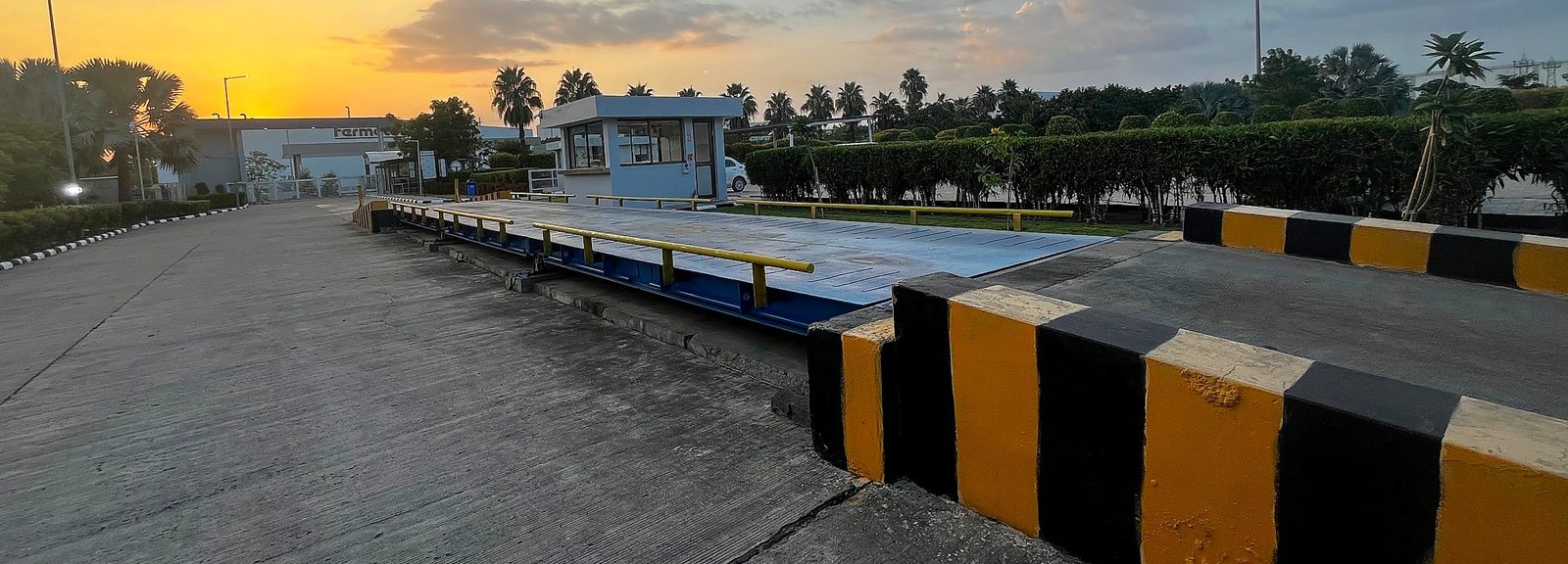
Khirasara GIDC weighbridges for foundry and engineering units.
Khirasara GIDC is an industrial estate in Rajkot district, part of the Saurashtra engineering belt that is where units such as foundries and fabricators work. Foundry returns, steel stock and finished components all travel by truck, and the price of every load depends on its weight. Symphony supplies weighbridges, truck scales and dharam kanta (धर्म कांटा / tol kanta) for engineering and processing units at Khirasara GIDC. In a metal yard the weight decides what you pay a scrap supplier and what you invoice a casting customer, so a small error repeats on every truck.
Engineering units at Khirasara GIDC normally order 60 MT over 16 m, pit-less steel, with a small cabin at the gate. Job-work shops that move parts on tempos and pickups can stay at 40 MT over 12 m. Foundries and steel traders unloading long trailers of ingot, pig iron or coal should move to 60–80 MT over 16–18 m, and a tenant who may relocate can choose a foundation-free modular weighbridge on level concrete. Our works ships about 2 weeks after a PO clears commercially, so the cabin and approaches can be ready first.
Scrap, ingots and castings: a weighbridge that takes the beating.
- Tough on scrap and castingsThick steel plates and strong cross-members suit foundry yards.
- Kept clean of scale and gritA closed junction box, sealed IP68/IP69K cells and a gap beneath that is easy to rinse.
- Slips by party and materialSMFW separates scrap, castings and fuel, and totals each shift.
Who needs one in Khirasara GIDC: Typical weighbridge users: casting and foundry units, machine-part and fabrication shops, steel and scrap traders, packaging and processing plants, and transport operators.
Also called a dharam kanta (धर्म कांटा), truck scale or weigh bridge. We also serve Rajkot, Lodhika, Metoda.
Foundries, job-work shops and metal traders across Khirasara GIDC.
Foundry and casting units
Heavy scrap and ingots hammer the platform all day.
Our setup: Suggested: 60–80 MT on 16–18 m, thick steel plates and sealed cells.
Fabrication and job-work shops
Parts leave on small vehicles in many short trips.
Our setup: Suggested: 40 MT on 12 m, low steel platform, with stamping support.
Steel and scrap traders
Mixed metal is bought and sold by the kilo.
Our setup: Suggested: 60 MT, 16 m, closed box, one slip per seller.
- Khirasara GIDC plotscasting, machine-part and fabrication units
- Rajkotcity engineering belt and trading yards
- Lodhikaindustrial and farm yards
- Metodaindustrial estate units
Grit, scale and loose scrap: siting a Khirasara weighbridge.
Foundry and fabrication yards are tough on a weighbridge. Heavy scrap, ingots and castings are dropped, dragged and driven over, so the platform needs thick steel plates, strong cross-members and a wear-resistant approach. Keep the weighing lane free of loose scrap and mark it clearly, because a stray billet under a wheel changes the reading. Give the platform one truck-length of straight, level ground on each side so the whole vehicle sits on it at once. Grit, scale and dust get into everything around a foundry, so pick a closed junction box with sealed IP68/IP69K cells and downward-facing glands, and rake out the gap under the platform every shift change. Because a plant often weighs a mix of scrap in, finished castings out and fuel or sand, SMFW can store each party and material and print a separate slip for each. Where the ground is uneven, a steel platform on pedestals is easy to level and quick to inspect. Furnaces and heavy motors cause supply dips, so use a UPS, earthing and a surge arrestor. A gate that runs through the night can use RFID tags, a camera and a barrier so regular trucks are weighed and logged unattended. A slip that settles a purchase needs Legal Metrology verification first and re-verified as required; we support the stamping paperwork. Send us a plot plan and one gate photo; the platform, approaches and cabin get marked on it. Place the cabin on the exit side with a clear view of the platform, and keep spare wear plates for the approach, since scrap trucks chew up the ramp edge first. If you buy scrap from many small sellers, store each seller as a party and set the tare of your regular vehicles in SMFW; the second weighing then takes seconds and the daily purchase register builds itself. Magnet cranes and loaders should never swing a load across the platform, so mark a no-swing zone beside it. Run a test load with a known weight at the start of each quarter and log it in the cabin register, so a disagreement with a supplier can be answered from the record. If you plan a second lane for dispatch, tell us now; the cabin and the SMFW record can be placed to serve both lanes without moving anything later. Foundry sand, slag and fettling waste also leave the yard by truck, and weighing them outbound gives you the disposal figure that a pollution-control file or a transporter's bill may ask for. Furnace shutdowns, annual maintenance and festival weeks change the traffic pattern, so check the lane plan once a year and move the marked bays if a new gate or stockyard has appeared. A short written weighing procedure pinned in the cabin, covering tare checks and who signs the slip, prevents most arguments.
| Recommended for | Vehicles | Capacity | Weighbridge | Type |
|---|---|---|---|---|
| Casting or foundry unit | Scrap and pig iron in, castings out | 60–80 MT | 16–18 m | Heavy steel plates, sealed IP68/IP69K cells |
| Job-work or fabrication shop | Parts moved on tempos and pickups | 40 MT | 12 m | Low steel platform for job-work lorries, verification support |
| Steel and scrap trader | Mixed metal on full trucks | 60 MT | 16 m | Raised steel, closed junction box, party-wise slips |
| Processing or packaging plant | Raw material in, cartons out | 60 MT | 16 m | Steel platform, gate cabin, SMFW slips for each consignee |
| Tenant on a short lease | Plot may change hands | 60 MT | 16 m | Modular weighbridge on a hard level slab, no foundation |
| Late-hours gate | Repeat trucks, no clerk | 60 MT | 16 m | Tag reader, camera and boom barrier on SMFW |
Starting points only. Send your heaviest truck and daily traffic and we confirm the size.
From a plot plan to the first slip: a Khirasara GIDC weighbridge in six steps.
Six steps for your project in Khirasara GIDC. Most of the waiting is the foundation curing, so the drawing comes first.
- 1 · Your traffic in Khirasara GIDCTell us the heaviest vehicle you weigh (here, typically scrap and pig iron in, castings out), the space at the gate and the daily count. An engineer replies within one working day.
- 2 · Size and quotationOur usual starting point (casting or foundry unit): 60–80 MT, 16–18 m weighbridge, Heavy steel plates, sealed IP68/IP69K cells. The quotation comes with the foundation drawing.
- 3 · Foundation on siteYour civil contractor builds the concrete pedestals to our drawing; we can check the levels before the weighbridge arrives.
- 4 · Fabrication and dispatchBuilt and tested in our Ahmedabad workshop; dispatch in about 2 weeks from a commercially cleared order with PO, then delivered and placed on your foundation.
- 5 · Installation and calibrationWeighbridge placed, load cells and indicator connected and calibrated, SMFW stored tares set up (RFID, cameras and boom barrier where ordered), and Legal Metrology verification supported.
- 6 · AMC and serviceAMC, breakdown visits, calibration and annual re-verification support from our technical desk, so the weighbridge stays accurate for years.
What Khirasara GIDC plant owners ask before ordering.
Who supplies weighbridges at Khirasara GIDC?
Which size suits a foundry yard?
How is the platform protected from scrap and grit?
Can a modular weighbridge be fitted?
Can scrap and finished goods be kept apart?
Does the slip need verification?
What decides the cost of a weighbridge at Khirasara GIDC?
खिरासरा जीआईडीसी में फाउंड्री के लिए वेब्रिज कैसे चुनें?
Limited-time offer: our weighbridge phone app (SMFW WOS) is free with your weighbridge. See what the app shows.
Tell us your site. We recommend the platform.
Send a site photo, vehicle size and daily vehicle count. An engineer replies within one working day.