
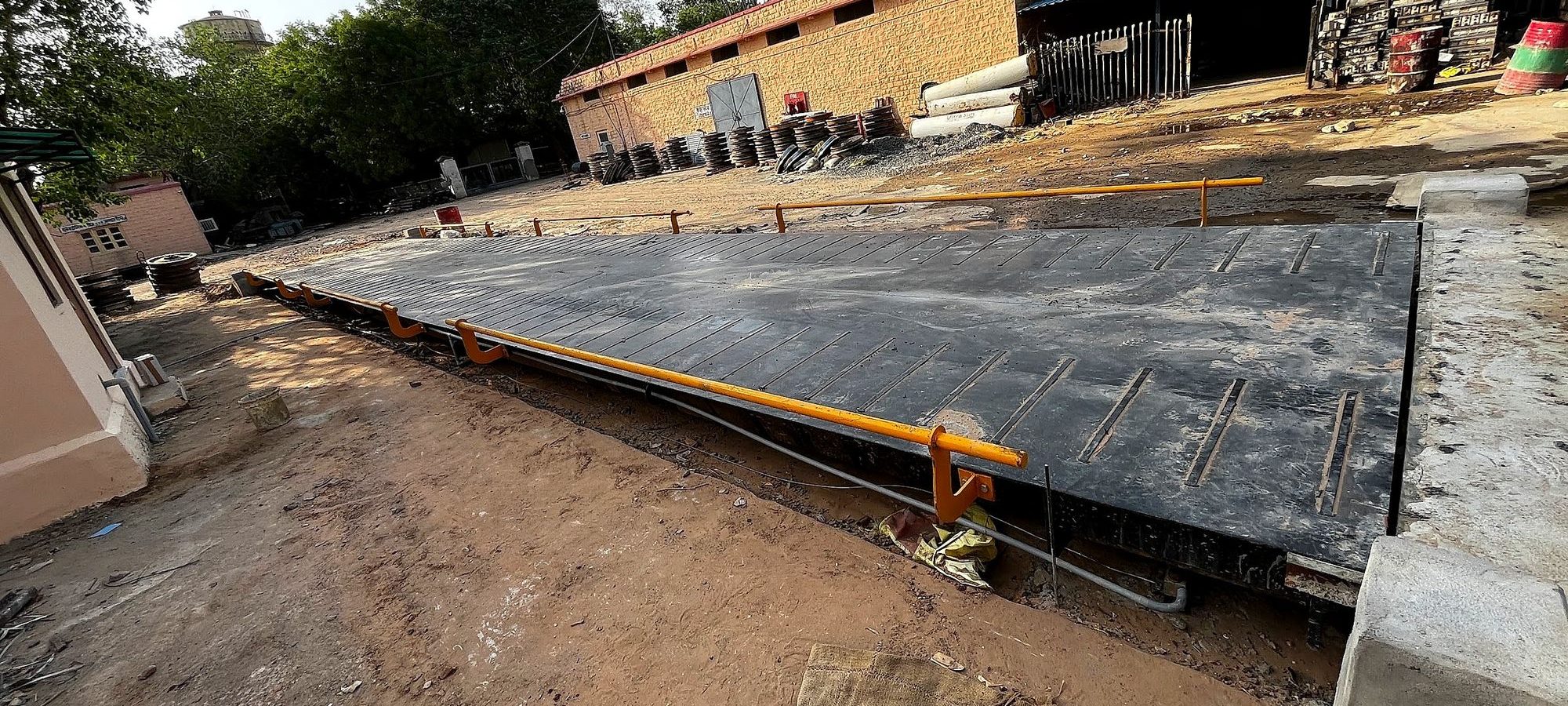
Ode GIDC weighbridges for feed, agro and packaging units.
Ode GIDC is an industrial estate in Anand district, in the Charotar farming region of central Gujarat. Wherever farm produce and feed move by truck, the weighbridge must keep pace and the slip must be ready before the driver has parked. Symphony supplies weighbridges, truck scales and dharam kanta (धर्म कांटा / tol kanta) for plants, workshops and yards at Ode GIDC, including feed, agro and packaging users.
For a feed or agro unit at Ode GIDC the usual choice is a 60 MT, 16 m pit-less steel weighbridge with the indicator in a small cabin at the gate. A workshop with tempos and pickups needs only 40 MT on 12 m; a plant taking long bulk trucks of cake, grain or polymer moves to 60–80 MT on 16–18 m; and a yard that may shift its layout can use a foundation-free modular weighbridge on level concrete. From a commercially cleared PO, dispatch from the Ahmedabad works takes about 2 weeks.
Busy gates, steady trucks: a weighbridge that keeps pace.
- Slips ready as the truck stopsA cabin on the exit side and stored tares keep each weighing to seconds.
- Built for dust and monsoon mudSealed cells, a closed junction box and a drained, paved apron keep the system working through the season.
- Grows with the plantA repeat display, second lane or unmanned gate can be added later on the same SMFW software.
Who needs one in Ode GIDC: Typical weighbridge users: cattle-feed and agro units, packaging and plastic makers, engineering shops, building-material yards and transport operators.
Also called a dharam kanta (धर्म कांटा), truck scale or weigh bridge. We also serve Anand, Petlad, Vithal Udyognagar.
Feed mills, packers and yards across Ode GIDC and Anand district.
Feed and agro units
Cake, grain and bagged feed move in volume and every lot is billed by weight.
Our setup: Suggested: 60 MT, 16 m pit-less steel, roofed cabin, stored-tare SMFW.
Packaging and plastic makers
Polymer and cartons arrive on long trucks that need a full platform.
Our setup: Suggested: 60–80 MT, 16–18 m steel with sealed cells.
Building-material yards
Loads change by the day and the yard layout may shift.
Our setup: Suggested: 60 MT modular weighbridge on level concrete, no foundation.
- Ode GIDC plots and estate roadsindustrial and agro-based units
- Ananddistrict trade and industrial yards
- Petladtrading yards
- Vithal Udyognagarindustrial units
Dust, mud and morning queues: siting an Ode weighbridge.
Most gates have a daily rhythm, and the weighbridge should follow it, with the slip ready in a minute for each truck. Put the cabin on the driver's side of the exit so the printed slip is handed over without the truck stopping twice. Keep one straight, level truck-length before and after the platform; a bend on the approach puts the front axle on the platform at an angle and spoils the reading. Fine dust from cake, husk or grain settles on the steel quickly, so choose a platform with a closed junction box and sealed IP68/IP69K cells and brush it down at shift change. Clay soil turns slippery after rain, so pave the apron, slope a drain beside each end and lift the platform on pedestals to keep the cells above standing water. A plant that weighs the same trucks every day can store each tare in SMFW and book loads to a party, so the second weighing is only one tap. Where trucks arrive before the cabin opens, RFID tags, a camera post and a boom barrier can log known carriers without a person on site. Supply dips when heavy motors start can restart a bare indicator, so use a UPS, earthing and a surge arrestor. A feed or grain bill is only as safe as its slip, so the platform should be verified under Legal Metrology before the first sale, then re-verified each year; stamping support from our side is part of the job. Count the busiest hour of the busiest month, not the average, when you decide whether one lane is enough or a second repeat display should be wired in from the start. Keep a spare printer ribbon and a spare slip roll in the cabin, because a feed unit that cannot print loses more time than one that is merely slow. Think also about who reads the slip: the driver wants it fast, the accounts clerk wants truck number, party and material, and the owner wants a day total that matches the stock register. Setting up SMFW with a short list of parties and materials on day one saves untidy corrections later. Walk the planned truck path once with the cabin operator and a driver before anything is poured. A plot sketch and a photo of the gate let us mark the platform, approaches and cabin before the contractor starts.
| Recommended for | Vehicles | Capacity | Weighbridge | Type |
|---|---|---|---|---|
| Cattle-feed or agro-processing unit | Grain and cake in, bagged feed out | 60 MT | 16 m | Raised steel, roofed cabin, closed junction box |
| Fabrication workshop | Steel stock in, jobs out by tempo | 40 MT | 12 m | Shallow steel platform, stamping support |
| Packaging or plastic maker | Polymer and cartons on long trucks | 60–80 MT | 16–18 m | Steel or RCC build, IP68/IP69K sealed cells |
| Trading or logistics yard | Many short trips with mixed loads | 60 MT | 16 m | Pit-less steel with a stored-tare vehicle list |
| Building-material yard | Sand, bricks and cement trucks | 60 MT | 16 m | Foundation-free modular on level concrete |
| Early-morning receiving lane | Known carriers before the cabin opens | 60–80 MT | 16–18 m | Tag reader, camera mast and barrier arm, run from SMFW |
Starting points only. Send your heaviest truck and daily traffic and we confirm the size.
From a plot photo to the first slip: an Ode GIDC weighbridge in six steps.
Six steps for your project in Ode GIDC. Most of the waiting is the foundation curing, so the drawing comes first.
- 1 · Your traffic in Ode GIDCTell us the heaviest vehicle you weigh (here, typically grain and cake in, bagged feed out), the space at the gate and the daily count. An engineer replies within one working day.
- 2 · Size and quotationOur usual starting point (cattle-feed or agro-processing unit): 60 MT, 16 m weighbridge, Raised steel, roofed cabin, closed junction box. The quotation comes with the foundation drawing.
- 3 · Foundation on siteYour civil contractor builds the concrete pedestals to our drawing; we can check the levels before the weighbridge arrives.
- 4 · Fabrication and dispatchBuilt and tested in our Ahmedabad workshop; dispatch in about 2 weeks from a commercially cleared order with PO, then delivered and placed on your foundation.
- 5 · Installation and calibrationWeighbridge placed, load cells and indicator connected and calibrated, SMFW stored tares set up (RFID, cameras and boom barrier where ordered), and Legal Metrology verification supported.
- 6 · AMC and serviceAMC, breakdown visits, calibration and annual re-verification support from our technical desk, so the weighbridge stays accurate for years.
What Ode GIDC feed and agro unit owners ask first.
Who supplies weighbridges at Ode GIDC?
What size suits a feed or agro unit?
How do we keep cake and husk dust out?
Can a modular weighbridge be used in the estate?
Can regular trucks be weighed faster?
Do slips need verification?
How many trucks can one lane handle in the morning rush?
Does a seasonal rush change the plan?
Can different vehicle types share the platform?
What decides the cost of a weighbridge at Ode GIDC?
ओडे जीआईडीसी में फीड या कृषि इकाई के लिए वेब्रिज कैसे चुनें?
Limited-time offer: our weighbridge phone app (SMFW WOS) is free with your weighbridge. See what the app shows.
Tell us your site. We recommend the platform.
Send a site photo, vehicle size and daily vehicle count. An engineer replies within one working day.