
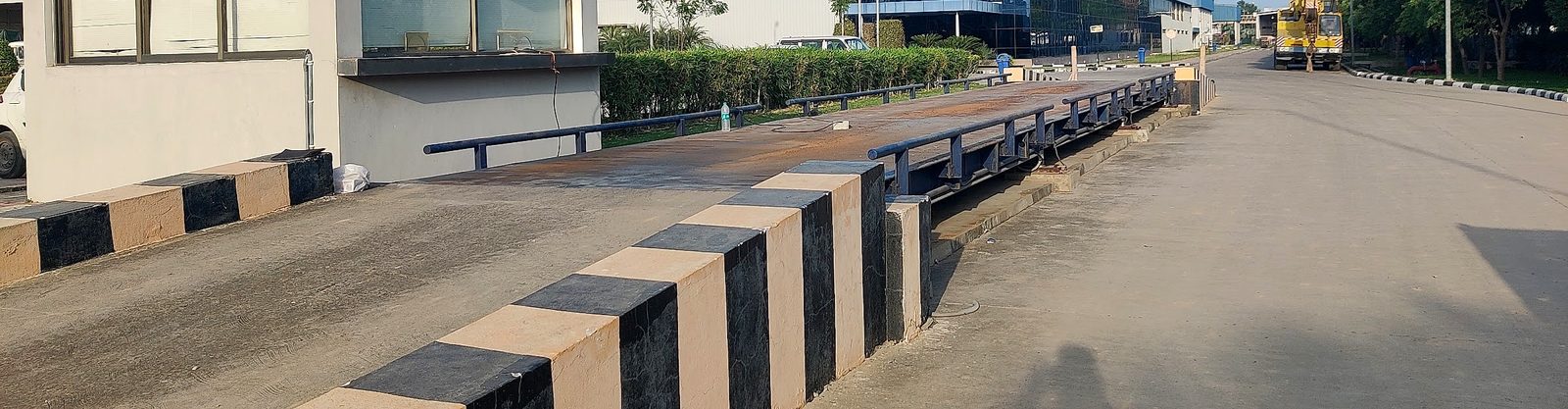
Khedbrahma weighbridges for maize, castor and stone yards.
Khedbrahma is a taluka town in northern Sabarkantha, on the Gujarat side of the Aravalli foothills, and is known across the country for its old Brahma temple, which draws pilgrims, especially around festivals. Around the town, hill-fed fields carry maize, castor, cotton and wheat, and the harvest reaches the market yard on tractors and pickups. Symphony supplies weighbridges, truck scales and dharam kanta (धर्म कांटा / tol kanta) for grain and castor traders, building-material and stone depots, workshops and transport owners in and around Khedbrahma. A hill-edge town has a particular weighing problem: loads come from many small holders, roads are narrow, and a seller who walks in with one tractor-trolley of maize wants to see the figure for himself. A clear display, a printed slip and a platform that stays level on uneven ground earn trust faster than any promise. Because the town sits where the hills meet the plain, sellers come in from scattered hamlets and expect quick weighing. On festival and pilgrim days the yard may also see extra trucks, so keep the weighing lane marked and easy to find.
For Khedbrahma traders we suggest a 50 MT weighbridge over 14 m in pit-less steel that takes a laden tractor-trolley and a ten-wheeler on the same platform, with a roofed clerk's window. Small dealers who handle pickups and mini-trucks can begin at 30 MT over 9 m. A stone or building-material yard that loads full tippers should look at 60–80 MT over 16–18 m. A trader who is active only in the maize and castor weeks can choose a modular platform on a levelled concrete slab, no pit. The works ships about 2 weeks after a PO clears commercially.
Many small sellers, one slip each: trust built on a clear display.
- Level on uneven groundThe slab and approaches are cut level so the platform sits level.
- Drains fast rainA sloped apron and raised pedestals keep storm water away from the cells.
- A slip every seller can readA large repeater display and a printed slip show each farmer his own weight.
Who needs one in Khedbrahma: Typical weighbridge users: maize, castor and grain traders, cotton and oilseed buyers, stone and building-material depots, workshop and fabrication units, fuel and supply distributors and transport owners.
Also called a dharam kanta (धर्म कांटा), truck scale or weigh bridge. We also serve Idar, Himmatnagar, Modasa.
Traders, depots and workshops across the Aravalli-foothill belt.
Maize and castor trading
Many small holders sell in the same few weeks of the season.
Our setup: Suggested: a 50 MT, 14 m steel platform with a concrete apron, a repeater display and a slip for each farmer.
Stone and building material
Tippers are loaded to the limit on sloping yards.
Our setup: Suggested: 60–80 MT on 16–18 m with sealed cells and a levelled slab.
Pilgrim-season suppliers
Festival-day traffic arrives in bursts.
Our setup: Suggested: 50 MT with a marked lane, a speed breaker well ahead of the approach and a marshal at the gate.
- Khedbrahma market yardmaize, castor and grain traders
- Idarquarries and agro yards
- Himmatnagardistrict engineering and trading
- Modasamarket and engineering yards
Sloping ground and fast runoff: siting a weighbridge at Khedbrahma.
Hill-edge ground is rarely flat, so the first job is to find a level, hard stretch that a truck can enter and leave without reversing on a slope. Where the yard rises or falls, cut the slab level and build the approaches to match instead of forcing the platform to follow the ground; a platform that leans on one side reads wrong and wears its cells unevenly. Rain runs fast off Aravalli slopes, so slope the apron to a drain on both sides and lift the platform on pedestals so storm water cannot pool beneath it. Loose stone and soil wash across yards after a storm, which is why a closed junction box, sealed IP68/IP69K load cells and a weekly clean of the gap suit this belt. Maize arrives in the same weeks as castor, and both are bought from many small holders, so SMFW can store each farmer as a party, note the crop and bag count and print a slip that the seller carries to the cashier. A seller who cannot read the display can be shown the number on a second, larger repeater facing the lane; a Gujarati notice on the window explaining how the tare is taken answers the usual question before it is asked. Festival-day traffic brings vehicles that do not know the yard, so paint the lane edges, put a speed breaker well ahead of the approach, keep the last stretch before the platform level and keep a marshal at the gate in busy weeks. Stone and building-material depots load tippers that exceed their rated capacity if no one checks, so a printed weight beside each invoice protects both the depot and the driver. Where supply is patchy, fit a UPS, earthing and a surge arrestor and keep a spare indicator cable in the cabin. For night or Sunday loading without a clerk, a tag on each regular vehicle can open the barrier after an RFID read and a camera photo. A payment slip is only as good as the platform's Legal Metrology verification, renewed on time; we help with the stamping paperwork. Send a yard photo with the gate marked, and the engineers sketch the platform, ramps and cabin on it before anyone digs. Four weeks before the buying season, have levels, cables and the printer checked and keep the certificate in a folder the clerk can reach. Sellers here may speak Gujarati, Hindi or a local dialect, so print the weight in large figures with the unit in kg, and train the clerk to read the number aloud once before handing over the slip. Where the yard sits on a hillside, a low wall or rubble bund on the uphill side turns runoff away from the slab. When the buying weeks end, cover the indicator, wash the platform and note the next verification date in the register.
| Recommended for | Vehicles | Capacity | Weighbridge | Type |
|---|---|---|---|---|
| Maize and grain trader | Tractor-trolleys in the harvest weeks | 50 MT | 14 m | Raised steel, concrete apron, farmer-wise slip |
| Castor or oilseed buyer | Lots from many small holders | 50 MT | 14 m | Steel platform, closed junction box, party-wise slips |
| Stone and building-material depot | Tippers and trucks loaded to the limit | 60–80 MT | 16–18 m | Heavy steel or RCC with sealed IP68/IP69K cells and a wash-down gap |
| Workshop or distributor | Pickups and mini-trucks | 30 MT | 9 m | Low steel platform on a level slab |
| Short-season buying yard | Active for a few weeks only | 50 MT | 14 m | Modular platform on a levelled concrete slab, no pit |
| Clerk-free gate for regulars | Tagged carriers on Sundays and nights | 60 MT | 15 m | RFID tag reader, camera and barrier linked to SMFW |
Starting points only. Send your heaviest truck and daily traffic and we confirm the size.
From a yard photo to the first slip: a Khedbrahma weighbridge in six steps.
Six steps for your project in Khedbrahma. Most of the waiting is the foundation curing, so the drawing comes first.
- 1 · Your traffic in KhedbrahmaTell us the heaviest vehicle you weigh (here, typically tractor-trolleys in the harvest weeks), the space at the gate and the daily count. An engineer replies within one working day.
- 2 · Size and quotationOur usual starting point (maize and grain trader): 50 MT, 14 m weighbridge, Raised steel, concrete apron, farmer-wise slip. The quotation comes with the foundation drawing.
- 3 · Foundation on siteYour civil contractor builds the concrete pedestals to our drawing; we can check the levels before the weighbridge arrives.
- 4 · Fabrication and dispatchBuilt and tested in our Ahmedabad workshop; dispatch in about 2 weeks from a commercially cleared order with PO, then delivered and placed on your foundation.
- 5 · Installation and calibrationWeighbridge placed, load cells and indicator connected and calibrated, SMFW stored tares set up (RFID, cameras and boom barrier where ordered), and Legal Metrology verification supported.
- 6 · AMC and serviceAMC, breakdown visits, calibration and annual re-verification support from our technical desk, so the weighbridge stays accurate for years.
What Khedbrahma traders and depot owners ask before ordering.
Who supplies weighbridges at Khedbrahma?
Which size suits a maize or castor yard?
What if our ground is sloping?
How do we handle monsoon runoff?
Can farmers see their own weight?
Does the slip need verification?
What decides the cost of a weighbridge at Khedbrahma?
खेड़ब्रह्मा में मक्का और अरंडी के व्यापार के लिए वेब्रिज कैसे चुनें?
Limited-time offer: our weighbridge phone app (SMFW WOS) is free with your weighbridge. See what the app shows.
Tell us your site. We recommend the platform.
Send a site photo, vehicle size and daily vehicle count. An engineer replies within one working day.