
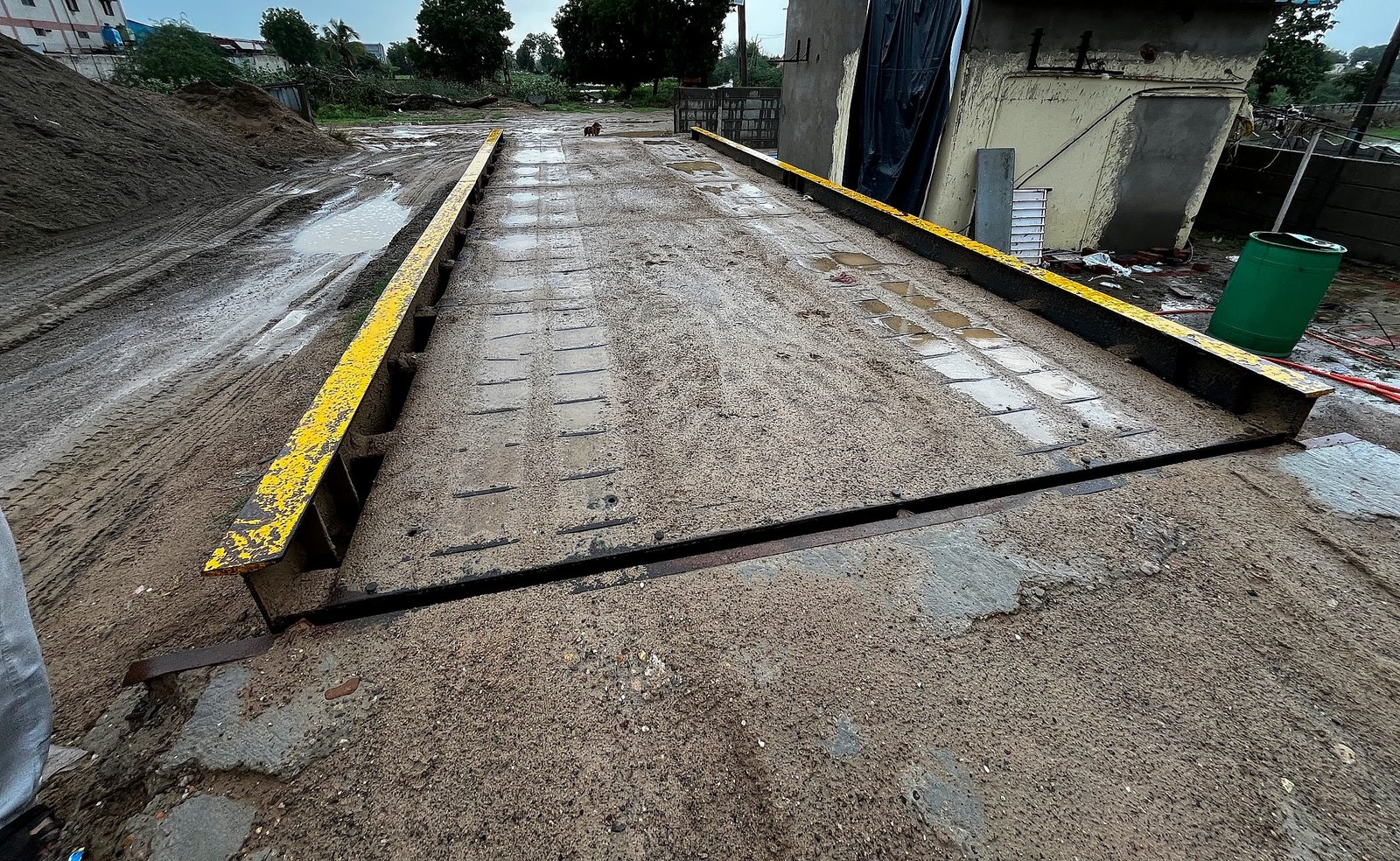
Kheralu weighbridges for traders, mills and godowns.
Kheralu is a taluka town in Mehsana district, set in the north Gujarat farm belt where crops such as castor, cumin, wheat and bajra are grown and traded in season. A town like this lives by its market yard and by the small mills and godowns that grow around it, and every one of them needs a trusted weight before money changes hands. Symphony supplies weighbridges, truck scales and dharam kanta (धर्म कांटा / tol kanta) for traders, processors and transport operators in and around Kheralu. Because the buying season is short and the sums are large, an honest, verified weight is what keeps a trader's relationship with the farmer intact.
At Kheralu most buyers settle on a 60 MT weighbridge, 16 m long, in pit-less steel, with the display in a roofed cabin beside the yard gate. Tractor-and-pickup godowns do well with 40 MT over 12 m. A mill unloading full trailers of seed or cake should look at 60–80 MT over 16–18 m, and a yard that trades only in season can put a foundation-free modular weighbridge on level concrete. Expect dispatch roughly two weeks after the PO is commercially cleared.
A short harvest window needs a weighbridge that never queues.
- Ready for the harvest rushA straight approach, paved apron and drains keep trolleys moving when the yard is full.
- Dust-tolerant buildClosed junction box and sealed IP68/IP69K cells shrug off husk and seed dust.
- One slip per lotSMFW stores the party and the commodity, so each farmer's lot has its own slip.
Who needs one in Kheralu: Typical weighbridge users: oilseed and castor traders, cattle-feed and agro mills, godown and warehouse operators, building-material suppliers, small engineering shops and transport owners.
Also called a dharam kanta (धर्म कांटा), truck scale or weigh bridge. We also serve Vadnagar, Vijapur, Mehsana.
Castor traders, feed mills and godowns across Kheralu's market belt.
Castor and oilseed trading
Lots are sold by weight in a short harvest window and every trolley is argued over.
Our setup: Suggested: 60 MT, 16 m steel on a paved, drained apron with a slip per party.
Cattle-feed and agro mills
Seed and cake move on long trailers, and dust settles on the platform.
Our setup: Suggested: 60–80 MT on 16–18 m, cells sealed against cake dust.
Godowns and warehouses
Pickups and tractors make short trips through a narrow gate.
Our setup: Suggested: a 40 MT, 12 m low steel platform and help with stamping.
- Kheralu industrial plotsagro and oilseed units, small workshops
- Vadnagartown yards
- Vijapurtown yards
- Mehsanadistrict trade and processing yards
Trolley lanes, husk and wet soil: siting a weighbridge at Kheralu.
Farm produce arrives in waves here. After harvest the yard fills with tractor-trolleys and trucks within a few days, then goes quiet, so the weighbridge must absorb a rush without a queue building on the road. Give the platform a straight approach on both sides so loaded trolleys can roll on without turning, and set the cabin where the clerk can see the driver and the trolley number together. Castor, cumin and grain carry dust and husk, which collect between the steel plates; a closed junction box, sealed IP68/IP69K load cells and a weekly brush-down keep readings steady. Where the soil softens when wet, pave the apron, slope it to a drain at either end and lift the platform on pedestals so water escapes beneath it. Traders who buy from the same farmers year after year can store party names in SMFW, print one slip per lot and total the day without a ledger. For loading after the clerk leaves, tagged vehicles can be read by an RFID reader, photographed and let through by a barrier, all on SMFW. If the supply is unsteady, add a UPS, good earthing and a surge arrestor. A slip that fixes a sale price must come from a weighbridge verified under Legal Metrology, and re-verified periodically as the rules require; we support with the stamping paperwork. Send us a plot photo and the gate position and we mark the platform, approaches and cabin before the contractor digs. Keep the slip printer inside the cabin, away from dust and sun, and let the driver read the display through a window so that a dispute is settled on the spot. Paint the edges of the weighing lane and put a speed breaker before the platform so that trolleys arrive slowly; a trolley hitting the platform at speed shakes the reading and wears the cells. Hand the cabin keys and the verification record to one named person, so that every weight can be traced to a day and a clerk. Before the season opens, run a test load with a known weight, such as a loaded tanker you have already weighed elsewhere, and write the result in the cabin register; it gives the whole yard one agreed starting point for the harvest weeks. If you add a second lane later, the same cabin and the same SMFW record can serve it, which is why we ask where you might expand before marking the first platform. Keep one printed copy of each slip with the driver and one in the cabin file, so the same number can be read back when a payment is queried.
| Recommended for | Vehicles | Capacity | Weighbridge | Type |
|---|---|---|---|---|
| Castor and oilseed trader | Trolleys in season, trucks out | 60 MT | 16 m | Raised steel, roofed clerk's cabin, closed junction box |
| Village godown or cold store | Tractors and pickups | 40 MT | 12 m | Low-rise steel platform with stamping support |
| Cattle-feed or agro mill | Seed and cake on full trailers | 60–80 MT | 16–18 m | Steel or RCC, sealed IP68/IP69K cells, dust-tight box |
| Market-yard weighing point | Rush weeks after harvest | 60 MT | 16 m | Paved apron, drains, party-wise SMFW slips |
| Seasonal yard | Used only some months of the year | 60 MT | 16 m | Bolt-together modular platform on a level concrete pad |
| Unattended night gate | Regular carriers loading late | 60 MT | 16 m | RFID reader, camera and barrier linked to SMFW |
Starting points only. Send your heaviest truck and daily traffic and we confirm the size.
From a plot photo to the first slip: a Kheralu weighbridge in six steps.
Six steps for your project in Kheralu. Most of the waiting is the foundation curing, so the drawing comes first.
- 1 · Your traffic in KheraluTell us the heaviest vehicle you weigh (here, typically trolleys in season, trucks out), the space at the gate and the daily count. An engineer replies within one working day.
- 2 · Size and quotationOur usual starting point (castor and oilseed trader): 60 MT, 16 m weighbridge, Raised steel, roofed clerk's cabin, closed junction box. The quotation comes with the foundation drawing.
- 3 · Foundation on siteYour civil contractor builds the concrete pedestals to our drawing; we can check the levels before the weighbridge arrives.
- 4 · Fabrication and dispatchBuilt and tested in our Ahmedabad workshop; dispatch in about 2 weeks from a commercially cleared order with PO, then delivered and placed on your foundation.
- 5 · Installation and calibrationWeighbridge placed, load cells and indicator connected and calibrated, SMFW stored tares set up (RFID, cameras and boom barrier where ordered), and Legal Metrology verification supported.
- 6 · AMC and serviceAMC, breakdown visits, calibration and annual re-verification support from our technical desk, so the weighbridge stays accurate for years.
What Kheralu traders and mill owners ask before ordering.
Who supplies weighbridges at Kheralu?
Which size suits a market-yard trader?
How do we protect it from seed dust and rain?
Can a seasonal yard use a modular weighbridge?
Can each lot get a separate slip?
Does the slip need verification?
What decides the cost of a weighbridge at Kheralu?
खेरालू में मंडी के व्यापारी के लिए वेब्रिज कैसे चुनें?
Limited-time offer: our weighbridge phone app (SMFW WOS) is free with your weighbridge. See what the app shows.
Tell us your site. We recommend the platform.
Send a site photo, vehicle size and daily vehicle count. An engineer replies within one working day.