
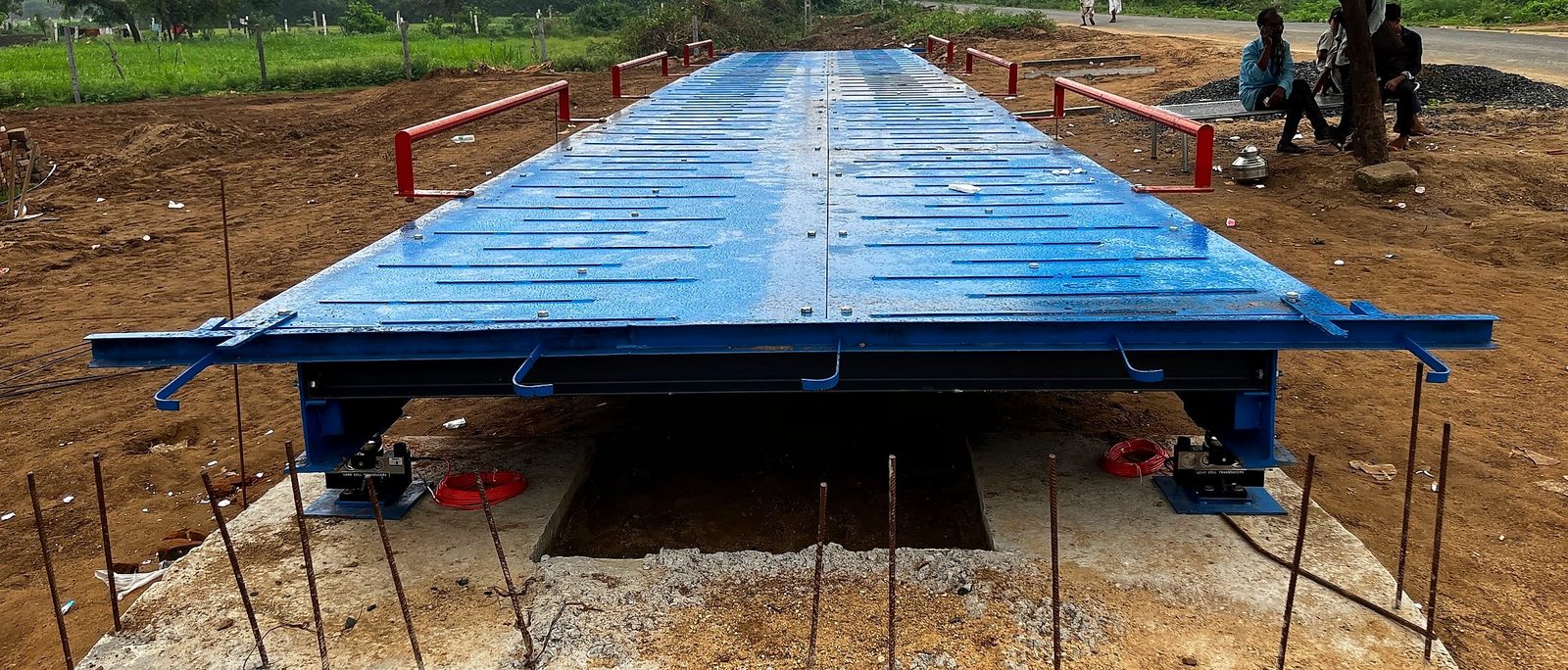
Jasdan weighbridges for crop yards and equipment makers.
Jasdan is a taluka town in Rajkot district, in Saurashtra, where groundnut, cotton and grain are among the crops typical of the region. District industry records also list a Jasdan agriculture-equipment cluster, so the town sells both what comes out of the fields and the machinery that works them. Both trades run on trucks and tractors, and both settle their accounts on a weight. Symphony supplies weighbridges, truck scales and dharam kanta (धर्म कांटा / tol kanta) for yards, mills and workshops in and around Jasdan. When a bag of groundnut or a casting for a plough is priced by the kilo, a trusted slip is part of the product. A yard that weighs for traders and buyers from other towns gives each of them a slip they can check. A trader who keeps the yard's weighing record can show it to a bank, an auditor or a buyer from another city, which is often the difference between a one-time lot and a regular account.
Most Jasdan yards begin with a 50 MT weighbridge over 14 m in pit-less steel, wide enough for a loaded tractor-trolley and long enough for a ten-wheeler. When a mill or processing unit joins the gate, 70–80 MT over 18 m takes a full trailer in a single weighing. Workshops that send machines out on small lorries can use 30 MT over 9 m. A yard that works only in the groundnut and cotton weeks can set a foundation-free modular weighbridge on level concrete. The works ships about 2 weeks after a PO clears commercially.
Groundnut, cotton and machines: one weighbridge, every slip trusted.
- Sized to the seasonA 50 MT platform covers tractors and trucks, with 70–80 MT planned for mills.
- Dust and lint kept outSealed cells and a closed box keep shell and cotton fluff off the electronics.
- Each farmer's lot on paperThe slip carries party, crop and weight for the whole season's record.
Who needs one in Jasdan: Typical weighbridge users: groundnut, cotton and grain traders, oil and cattle-feed mills, agricultural-equipment makers and fabricators, building-material yards, godown operators and transport owners.
Also called a dharam kanta (धर्म कांटा), truck scale or weigh bridge. We also serve Rajkot, Vinchhiya, Botad.
Traders, mills and workshops across Jasdan's farm economy.
Groundnut and cotton trading
Yards can fill with tractor-trolleys during the buying weeks.
Our setup: Suggested: 50 MT on 14 m, paved apron and one slip per farmer.
Plough, tiller and tank makers
Finished machines leave on mixed lorries against invoices.
Our setup: Suggested: 30 MT on 9 m low platform, with stamping support.
Mills and processing units
Seed, cake and bales can arrive on long trailers in dusty air.
Our setup: Suggested: 70–80 MT on 18 m, cells sealed against lint.
- Jasdan agriculture-equipment unitsworkshops and fabricators
- Vinchhiyatown yards
- Rajkotcity engineering and trading yards
- Botadmarket yards
Shell dust, lint and heavy soil: siting a weighbridge at Jasdan.
Saurashtra soil is dry for most of the year but turns heavy after a good monsoon, so pave the apron, slope it to a drain on each side and lift the platform on pedestals so that water never stands under it. Groundnut shell, cotton lint and dust drift into every gap; a closed junction box, sealed IP68/IP69K load cells and a weekly brush-down under the platform keep readings steady. During the buying weeks the yard fills with tractors and trucks together, so give the platform a straight run-on and run-off and mark a waiting bay off the road, so that the queue never spills onto the highway. Keep the display where the driver can read it through a window while the clerk watches the vehicle number. A trader who buys the same crop from many farmers can store each party in SMFW, print one slip per lot and close the day's total without a ledger. Workshops that dispatch ploughs, tillers and tanks can record the dispatch weight against the invoice number. For a late-night gate, tagged vehicles can be read by RFID, photographed and let through by a boom barrier, all on SMFW. A weak supply is common in farm-side yards, so fit a UPS, good earthing and a surge arrestor. A slip that settles a price must come from a weighbridge passed under Legal Metrology and re-verified as the rules require; we help with the stamping paperwork. Send a plot photo and the gate position, and the platform, approaches and cabin are marked on it before the contractor digs. A weighbridge laid out for a busy buying morning has a long holding bay inside the compound, a one-way loop that returns the trolley to the road without reversing, and a display that is readable from the driver's seat. Groundnut sold in bags and groundnut sold loose are weighed differently, so SMFW lets the clerk tick the packing type and deduct a standard bag tare, which keeps the farmer's arithmetic and the buyer's arithmetic the same. Cotton arrives lighter and bulkier, so the same tractor weighs little for its size; mark the platform length so that the trolley and the tractor both stand fully on it. Equipment makers can print the dispatch weight on the delivery challan, and a buyer from another district can phone the yard and be read the slip number. Keep a duplicate slip book for the days when the printer ribbon runs out, and ask the clerk to write the slip number on the gate pass, so a lorry cannot leave without a weighment. Farmers trust what they can see, so a large, bright display facing the driver does as much for goodwill as the accuracy certificate. Pin a printed rate board and a Hindi or Gujarati notice beside the window explaining how the tare is taken, and the same questions stop being asked a dozen times a day. In the quiet months, use the time to inspect the cables, repaint the platform edges, re-level the pedestals and run a known test load; the weighbridge is then ready for the next season without a surprise on the first heavy morning. Before the buying weeks begin, walk the lane with the clerk and the driver who comes first each morning. Ask where the trolleys line up, where the sun falls on the display, and which corner collects water after rain. Those three answers decide the position of the cabin, the slope of the apron and the side on which the printer sits. A yard that fixes them on paper in the quiet months does not need to move anything when the first heavy day arrives. Also agree in advance who may cancel a slip, who may change a party name and who keeps the daily printout, so that every correction leaves a trace in the SMFW record.
| Recommended for | Vehicles | Capacity | Weighbridge | Type |
|---|---|---|---|---|
| Groundnut buyer at the yard | Tractor-trolleys all day in season | 50 MT | 14 m | Raised steel platform with a roofed clerk's window |
| Plough and tiller maker | Finished machines on small lorries | 30 MT | 9 m | Low steel platform; invoice number stored with each weight |
| Mill or processing unit | Full trailers of seed, bales and cake | 70–80 MT | 18 m | RCC or heavy steel, sealed IP68/IP69K cells, dust-tight box |
| Grain dealer | Mixed bags and loose grain | 50 MT | 14 m | Paved apron, drains, party-wise slips |
| Part-year godown | Busy only some months | 50 MT | 14 m | Modular weighbridge on a level concrete pad, no foundation |
| Night dispatch gate | Regular carriers after the clerk leaves | 60 MT | 16 m | RFID reader, camera and boom barrier on SMFW |
Starting points only. Send your heaviest truck and daily traffic and we confirm the size.
From a plot photo to the first slip: a Jasdan weighbridge in six steps.
Six steps for your project in Jasdan. Most of the waiting is the foundation curing, so the drawing comes first.
- 1 · Your traffic in JasdanTell us the heaviest vehicle you weigh (here, typically tractor-trolleys all day in season), the space at the gate and the daily count. An engineer replies within one working day.
- 2 · Size and quotationOur usual starting point (groundnut buyer at the yard): 50 MT, 14 m weighbridge, Raised steel platform with a roofed clerk's window. The quotation comes with the foundation drawing.
- 3 · Foundation on siteYour civil contractor builds the concrete pedestals to our drawing; we can check the levels before the weighbridge arrives.
- 4 · Fabrication and dispatchBuilt and tested in our Ahmedabad workshop; dispatch in about 2 weeks from a commercially cleared order with PO, then delivered and placed on your foundation.
- 5 · Installation and calibrationWeighbridge placed, load cells and indicator connected and calibrated, SMFW stored tares set up (RFID, cameras and boom barrier where ordered), and Legal Metrology verification supported.
- 6 · AMC and serviceAMC, breakdown visits, calibration and annual re-verification support from our technical desk, so the weighbridge stays accurate for years.
What Jasdan traders and workshop owners ask before ordering.
Who supplies weighbridges at Jasdan?
Which size suits a groundnut or cotton yard?
How do we protect it from shell dust and rain?
Can an agricultural-equipment maker record dispatch weights?
Can a seasonal yard use a modular weighbridge?
Does the slip need verification?
What decides the cost of a weighbridge at Jasdan?
जसदण में मूंगफली और कपास के व्यापारी के लिए वेब्रिज कैसे चुनें?
Limited-time offer: our weighbridge phone app (SMFW WOS) is free with your weighbridge. See what the app shows.
Tell us your site. We recommend the platform.
Send a site photo, vehicle size and daily vehicle count. An engineer replies within one working day.