
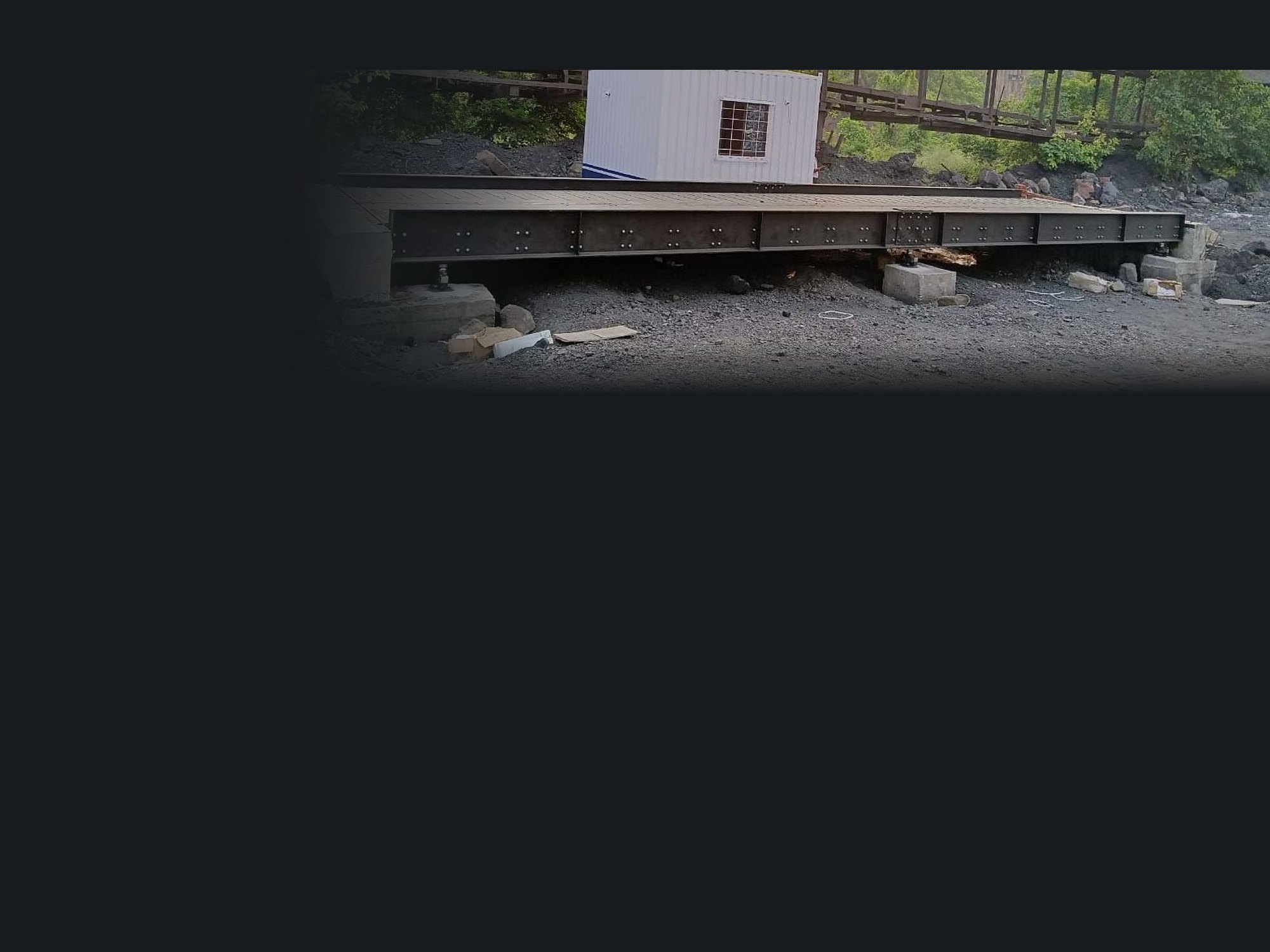
Umaria weighbridges for the collieries, the ash bulkers and the mandi.
Umaria, the coal town on the Umrar where the Katni–Bilaspur rail line runs along the edge of the Bandhavgarh forests, is a district of collieries, a power station and small-holder grain. The collieries of the Umaria–Johila coalfield around Nowrozabad, Umaria and Birsinghpur Pali send coal by the tipper to the sidings and to the thermal power station at Birsinghpur Pali, whose fly ash leaves by the bulker for the brick plants and the cement grinders; the sandstone quarries and crushers of the Umrar and Johila valleys load grit and stone for the roads and the housing of the district; the Krishi Upaj Mandi yards and sub-yards at Umaria, Chandia, Manpur and Nowrozabad trade paddy, wheat, gram, lentil and the kodo and kutki of the plateau villages; rice mills, flour mills and dal mills work the mandi grain; and tendu leaf, mahua and bamboo leave the forest depots by the truck each season. Symphony supplies weighbridges, truck scales and dharam kanta (धर्म कांटा / tol kanta) across Umaria district.
A coal transporter, a mine contractor or a siding depot around Nowrozabad, Umaria or Birsinghpur Pali takes a 100 MT weighbridge on 18 m, pit-less steel or concrete (RCC), stamped for trade, built for a loaded coal tipper and a multi-axle trailer on the same platform, with IP67/IP68 sealed load cells against coal fines and the unmanned option (RFID, cameras, boom barrier) for a depot that loads in three shifts; a fly-ash transporter or a brick plant on the Birsinghpur Pali side 80–100 MT on 18 m with an RCC top that ash does not attack; a sandstone quarry or a crusher in the Umrar or Johila valley 80–100 MT on 18 m; a rice mill, a flour mill or a mandi commission agent at Umaria, Chandia, Manpur or Nowrozabad 40–60 MT on 12–16 m, so a tractor-trolley of paddy or kodo and a loaded 10-wheel truck both read in one pass; a forest-produce depot 40–60 MT on 12–16 m with a weatherproof cabin; a public weighbridge on the Katni or Shahdol road 60–100 MT on 16–18 m (dharam kanta). Symphony builds it in Ahmedabad and dispatches it about 2 weeks after a commercially cleared order with PO.
Coal fines, fly ash and three shifts at the siding: why an Umaria weighbridge is sealed and built heavier.
- Coal fines that turn to paste in the rains, tippers and trailers on one platform, depots that load in three shifts100 MT on 18 m, sealed IP67/IP68 load cells, potted junction box, the unmanned option, slips by colliery and consignee.
- Fly ash by the bulker, sandstone by the tipper, dropped stone at the crusher80–100 MT on 18 m with an RCC top that ash does not attack, stored bulker tares, reports by size and vehicle.
- Sandstone close under the soil, valley loam that holds water, a river that rises fast in JulyShallow pedestals on the rock or deeper ones in the loam; a raised pit-less platform above the flood line.
Who needs one in Umaria: Coal transporters and mine contractors of the collieries around Nowrozabad, Umaria and Birsinghpur Pali; coal depots and siding transporters on the Katni–Bilaspur line; fly-ash transporters and bulker operators serving the thermal power station at Birsinghpur Pali; fly-ash brick plants and cement-grinding suppliers; sandstone quarries, stone crushers and grit suppliers of the Umrar and Johila valleys; commission agents and grain buyers at the Umaria, Chandia, Manpur and Nowrozabad Krishi Upaj Mandis; rice mills, flour mills, dal mills and oil expellers; kodo-kutki millet traders of the plateau villages; forest-produce depots and traders of tendu leaf, mahua, sal seed and bamboo; brick kilns; road, rail and irrigation contractors; engineering and fabrication workshops serving the mines; transporters and warehouses on the Katni, Shahdol, Rewa and Dindori roads; public dharam kanta operators.
Also called a dharam kanta (धर्म कांटा), truck scale or weigh bridge. We also serve Nowrozabad, Birsinghpur Pali, Chandia, Manpur, Karkeli, Tala, Ghunghuti.
Coal depots, ash transporters, crushers and mandi traders across Umaria district.
Coal transporters, siding depots and mine contractors
Coal leaves the collieries around Nowrozabad, Umaria and Birsinghpur Pali by the tipper for the sidings and the power station, the depot weighs every load in and out in three shifts, and the fines settle on every seal and turn to paste in the rains.
Our setup: A 100 MT, 18 m weighbridge in pit-less steel or RCC, built for a loaded tipper and a multi-axle trailer on the same platform, with IP67/IP68 sealed load cells, a potted junction box, cable in closed conduit, the unmanned option (RFID, cameras, boom barrier) and SMFW slips by vehicle, colliery and consignee.
Fly-ash transporters, brick plants and crushers
Fly ash leaves the power station at Birsinghpur Pali by the bulker for the brick plants and the cement grinders, sandstone and grit leave the quarries and crushers of the Umrar and Johila valleys by the tipper, and ash and dropped stone both wear a plain painted platform.
Our setup: An 80–100 MT, 18 m weighbridge with a concrete (RCC) top that ash and stone do not attack, which carries a 25-year structural warranty, sealed load cells, a stored tare for every regular bulker and SMFW reports by size, party and vehicle.
Mandi traders, mills and forest depots
Paddy and the kodo and kutki of the plateau villages come to the mandis at Umaria, Chandia, Manpur and Nowrozabad from October by the tractor-trolley and the pick-up, wheat and gram follow from March, the mills take mandi grain in and send products out by the truck, and the forest depots weigh tendu, mahua and bamboo by the truck for a few weeks a year.
Our setup: A 40–60 MT, 12–16 m pit-less steel weighbridge, stamped, that reads a pick-up accurately at the low end and a loaded 10-wheel truck at the high end, with SMFW grain-in and product-out reports, a stored tare for each regular tractor and, at a depot, a weatherproof cabin and a dust cover for the indicator.
- Umaria town and the Katni roadthe Krishi Upaj Mandi, rice and flour mills, coal transporters, workshops, warehouses
- Nowrozabad and the colliery beltcollieries, coal depots, the sidings, mine contractors, engineering workshops
- Birsinghpur Palithe thermal power station, fly-ash transporters, brick plants, the Pali station and siding
- Chandia and the Umrar valleythe Chandia mandi, rice and dal mills, sandstone quarries, crushers, the Katni road
- Manpur, Tala and the Bandhavgarh sidethe Manpur mandi, millet traders, forest depots, the Rewa road
- Karkeli and Ghunghutiforest-produce depots, tendu and mahua traders, paddy villages, the Shahdol and Dindori roads
Sandstone close under Umaria, loam in the Johila valley: founding a weighbridge in the coal belt.
Coal fines are the first thing an Umaria weighbridge has to live with. The collieries around Nowrozabad, Umaria and Birsinghpur Pali send coal by the tipper to the sidings on the Katni–Bilaspur line and to the power station, the depots and the transporters weigh every load in and out, and the fines settle on the platform, the rails, the cabin glass and anything with a seal, and they turn to a black paste in the rains. The coal transporter's or the siding depot's weighbridge is therefore 100 MT on 18 m, pit-less steel or concrete (RCC), stamped for trade and built for a loaded tipper and a multi-axle trailer on the same platform, with IP67/IP68 sealed load cells, a junction box potted again on site and cable in closed conduit so the fines and the wash-down water stay out; the unmanned option (RFID, cameras, boom barrier) lets a depot that loads in three shifts clear its tippers without a clerk in the cabin, and SMFW gives the transporter a slip by vehicle, colliery and consignee that the siding and the buyer both accept. The power station at Birsinghpur Pali adds the second kind of load: fly ash leaves by the bulker for the brick plants and the cement grinders, and ash is fine, alkaline and gets into everything, so the ash transporter's and the brick plant's weighbridge is 80–100 MT on 18 m with a concrete (RCC) top that ash does not attack, which carries a 25-year structural warranty, sealed load cells and a stored tare for every regular bulker, so the bulker is weighed loaded and the tare is not re-weighed every trip. Sandstone is the district's building stone: the quarries and crushers of the Umrar and Johila valleys load grit, stone and block for the roads, the railway works and the housing of the district by the tipper, and dropped stone wears a plain platform, so the crusher takes 80–100 MT on 18 m with an RCC top and SMFW reports by size and vehicle. Grain is the quieter trade. The paddy of the Johila and Umrar valleys and the kodo and kutki of the plateau villages come to the Krishi Upaj Mandis at Umaria, Chandia, Manpur and Nowrozabad from October by the tractor-trolley and the pick-up, wheat and gram follow from March, and the rice mills, flour mills and dal mills around Umaria and Chandia take the mandi grain in by the truck and send grain products out by the truck, so a mill or a commission agent takes a 40–60 MT, 12–16 m pit-less steel weighbridge, stamped for trade, with SMFW grain-in and product-out reports and a stored tare for every regular tractor; a millet trader wants the low end of the platform to read a pick-up accurately, which a Class III OIML R76 instrument does. The forest depots handle mahua in March and April, tendu leaf in May and June and bamboo in the cold months, each by the truck and each finished within weeks, so a depot is served by a 40–60 MT, 12–16 m pit-less steel platform whose cabin is weatherproofed and whose indicator stays covered between seasons. The ground is Gondwana sandstone and shale close under a thin red soil on the coal side and laterite and gravel on the plateau towards Manpur and Tala, so the short pedestals of a pit-less platform sit straight on the rock, while a pit would be slow to cut and quick to flood; in the Johila and Umrar valleys the soil is a deeper loam that holds water, so there the pedestals go lower and the approaches are given a fall to a drain. The monsoon brings a little over a metre of rain between June and September and the Johila and the Umrar rise fast, so a yard on the riverbank is raised clear of the July high water and most Umaria buyers prefer a pit-less platform standing proud of the ground to a pit. In May the heat passes 45 °C and the wind carries coal dust, so the cabin is kept shaded and closed, and the test weights go on the platform early in the day. The Bandhavgarh tiger reserve and its reserved forests are left alone; Umaria's weighbridges work at the collieries, the sidings, the mandis, the crushers and the depots. An Umaria depot or mill should plan Legal Metrology verification, or the yearly re-verification, for August, using Symphony's stamping support, so the platform is verified before the paddy arrives and the winter coal despatch picks up.
| Recommended for | Vehicles | Capacity | Weighbridge | Type |
|---|---|---|---|---|
| Coal transporter, mine contractor or siding depot, Nowrozabad, Umaria or Birsinghpur Pali | Loaded coal tippers, multi-axle trailers | 100 MT | 18 m | Pit-less steel or RCC, stamped, unmanned option |
| Fly-ash transporter or brick plant, Birsinghpur Pali side | Ash bulkers, brick trucks | 80–100 MT | 18 m | RCC top, stamped |
| Sandstone quarry or stone crusher, Umrar or Johila valley | Loaded tippers, 10- and 12-wheelers | 80–100 MT | 18 m | RCC top, stamped |
| Rice mill, flour mill or dal mill, Umaria or Chandia | Grain trucks, tractor-trolleys | 40–60 MT | 12–16 m | Pit-less steel, stamped |
| Mandi commission agent or millet trader, Umaria, Chandia, Manpur or Nowrozabad | Tractor-trolleys, pick-ups, 10-wheel trucks | 40–60 MT | 12–16 m | Pit-less steel, stamped |
| Forest-produce depot or public weighbridge, Katni or Shahdol road | Tendu and bamboo trucks, trolleys to trailers | 40–100 MT | 12–18 m | Pit-less steel or RCC, stamped |
Starting points only. Send your heaviest truck and daily traffic and we confirm the size.
Depot-gate drawing at Nowrozabad to the first stamped coal tipper: the Umaria order, stage by stage.
Six steps for your project in Umaria. Most of the waiting is the foundation curing, so the drawing comes first.
- 1 · Your traffic in UmariaTell us the heaviest vehicle you weigh (here, typically loaded coal tippers, multi-axle trailers), the space at the gate and the daily count. An engineer replies within one working day.
- 2 · Size and quotationOur usual starting point (coal transporter, mine contractor or siding depot, Nowrozabad, Umaria or Birsinghpur Pali): 100 MT, 18 m weighbridge, Pit-less steel or RCC, stamped, unmanned option. The quotation comes with the foundation drawing.
- 3 · Foundation on siteYour civil contractor builds the concrete pedestals to our drawing; we can check the levels before the weighbridge arrives.
- 4 · Fabrication and dispatchBuilt and tested in our Ahmedabad workshop; dispatch in about 2 weeks from a commercially cleared order with PO, then delivered and placed on your foundation.
- 5 · Installation and calibrationWeighbridge placed, load cells and indicator connected and calibrated, SMFW stored tares set up (RFID, cameras and boom barrier where ordered), and Legal Metrology verification supported.
- 6 · AMC and serviceAMC, breakdown visits, calibration and annual re-verification support from our technical desk, so the weighbridge stays accurate for years.
Questions from Umaria's coal transporters, brick plants and mandi traders.
Who supplies weighbridges in Umaria?
Which weighbridge suits a coal transporter or a siding depot in Umaria?
Which weighbridge suits a fly-ash transporter, a crusher or a mandi trader in Umaria?
How long does an Umaria weighbridge take to arrive?
What decides the cost of a weighbridge in Umaria?
उमरिया में कोयला परिवहन, फ्लाई ऐश या मंडी व्यवसाय के लिए धर्म कांटा कैसे स्थापित करें?
Tell us your site. We recommend the platform.
Send a site photo, vehicle size and daily vehicle count. An engineer replies within one working day.