
Weighbridges for salt works and coastal sites.
How to choose a weighbridge (dharam kanta) for salt pans, ports and coastal plants: concrete vs steel, sealed load cells, drainage, earthing and upkeep.
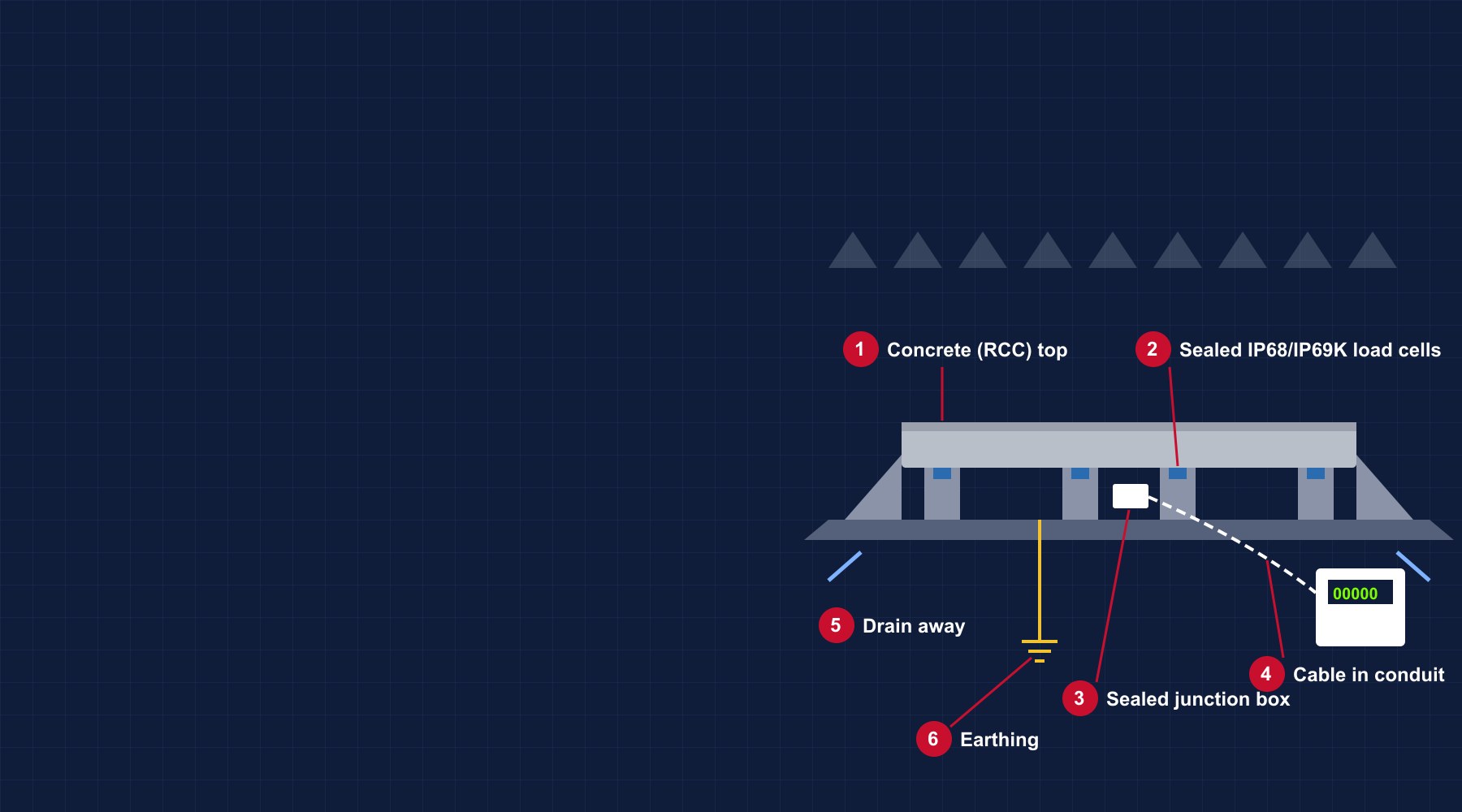
For a salt works, port or coastal plant, choose a concrete (RCC) or steel-cum-RCC weighbridge, sealed IP68 / IP69K load cells, drainage away from the weighbridge and proper earthing. Symphony builds RCC and steel-cum-RCC weighbridges from 10 to 100 MT and supplied three 100 MT steel-cum-RCC weighbridges to Sambhar Salts.
Short answer: at a salt works, port or coastal plant, choose a concrete (RCC) weighbridge or steel-cum-RCC for heavy duty, fit sealed IP68 / IP69K load cells, keep water and brine draining away from the weighbridge, and earth it properly. The weighing parts are the same as anywhere else; what changes is how well the weighbridge is protected from salt, water and corrosion. Symphony builds RCC and steel-cum-RCC weighbridges from 10 to 100 MT.
Why salt and sea air are hard on a weighbridge
Salt is not only on the trucks. At a salt pan, wet salt falls from every tipper, brine runs off the load and the soil itself is saline. Near the sea, the air carries chloride that settles on every steel surface and every cable gland. Three things follow:
- Exposed steel rusts fastPaint chips under wheels and loading, and salt works into the gap. A painted steel platform needs regular touch-up to keep its strength.
- Water finds the electronicsA junction box that is not sealed, a cable gland left loose or a cable lying in a wet trench is the usual start of drifting readings.
- Concrete needs the right mixChlorides that reach the steel bars inside poor concrete make them rust and crack the concrete from inside. Mix, cover and curing decide how long it lasts.
Gujarat produced about 85% of India’s salt in 2021-22 (227.64 of 266 lakh tonnes; Indian Bureau of Mines, Indian Minerals Yearbook 2022, Salt chapter), so the coast from Kutch to Bhavnagar is where these questions come up most often.
Concrete, steel-cum-RCC or steel: which one?
| Type | How it handles salt | Best for |
|---|---|---|
| Concrete (RCC) | Concrete top, no paint to fail; 25-year structural warranty on the RCC concrete (T&C apply) | Salt pans, washeries, refineries, fertiliser and chemical plants |
| Steel-cum-RCC | Steel structure filled with concrete; heavy duty with less exposed steel | High-traffic salt works and bulk yards, up to 100 MT |
| Steel | Strong and quick to install, but needs a good paint system and regular repainting | Port yards and coastal sites away from direct brine, or where the weighbridge may be moved (portable / modular) |
Symphony supplied three 100 MT steel-cum-RCC weighbridges (16 × 3 m) to Sambhar Salts in Rajasthan. Our steel vs concrete guide compares the two in more detail, and the concrete weighbridge page lists sizes from 10 to 100 MT and 7 to 18 m.
Load cells, junction box and cables
Most breakdowns at coastal sites begin with water in the electronics, not with the steel. Ask for these points in the quotation:
- IP68 / IP69K load cellsSealed cells that are made to stay dry under water and high-pressure washing. Symphony uses IP68 / IP69K load cells.
- Sealed junction boxPlaced above the water line, with every cable gland tightened and the lid gasket checked at each service.
- Cables in conduitRun in conduit or a covered duct to the weigh cabin, never loose in a wet trench where trucks and tools can damage them.
- Earthing and surge protectionA tested earth pit and surge protection. Coastal areas see heavy monsoon storms, and lightning is a common cause of indicator damage.
Ask the supplier to show the junction box position and conduit route on the foundation drawing. For the full list of causes, see why load cells fail.
Foundation and drainage at the coast
IS 456:2000 (Tables 3, 5 and 16), the Indian code for plain and reinforced concrete, sets these minimums for reinforced concrete. Your civil engineer confirms which class applies to your plot.
| Exposure (IS 456) | Min. grade | Max. water-cement ratio | Nominal cover |
|---|---|---|---|
| Severe: coastal environment | M30 | 0.45 | 45 mm |
| Very severe: sea-water spray | M35 | 0.45 | 50 mm |
| Extreme: tidal zone | M40 | 0.40 | 75 mm |
- Choose pit-less where possibleA pit holds rain and brine. A pit-less weighbridge on raised pedestals stays drier and is easier to wash.
- Slope the ground awayApproaches and the area around the pedestals should drain away from the weighbridge, not towards it.
- Cure the concrete fullyGood curing closes the surface and slows chloride getting in. Rushing the weighbridge onto green concrete shortens its life.
- Get the drawing firstSymphony gives free civil consultation and a foundation drawing for your size. The foundation guide explains each step.
Upkeep that pays back
A short routine keeps a coastal weighbridge accurate and cuts repair calls:
| How often | What to do |
|---|---|
| Daily or each shift | Clear salt, mud and stones from the gaps between the platform and the foundation |
| Weekly in the salt season | Wash the platform and the pedestal area with fresh water |
| Monthly | Check the junction box seal, cable glands and conduit; look for rust spots on any exposed steel |
| Before the monsoon | Test the earthing, clear the drains and check the surge protection |
| Every 12 months | Calibration check and Legal Metrology re-verification of the weighbridge |
Symphony offers annual maintenance contracts (AMC) and Legal Metrology re-verification support. The maintenance checklist lists what your own team can do between visits.
Size for the salt season
Salt is harvested in a dry-season peak, when tippers and trailers shuttle between pans, washeries and the refinery or port. Size the weighbridge for the heaviest loaded vehicle in that peak, with headroom: for salt tippers and trailers this usually means 60 to 100 MT on a 16 or 18 m platform, so the longest trailer stands fully on it. 60, 80 or 100 ton explains the choice, and our free weighbridge tools show what a small weighing error costs in a year and when your re-verification is due.
Salt and coastal areas we serve
Symphony builds in Ahmedabad and installs, calibrates and supports stamping on site. See our pages for Gandhidham, Mundra, Jamnagar, Porbandar, Bhavnagar, Dahej and Rajasthan (Sambhar), or ask for a quotation for your site.
हिंदी में: नमक उद्योग एवं तटीय संयंत्रों के लिए कंक्रीट (RCC) अथवा स्टील-कम-RCC वेब्रिज (धर्म कांटा), सीलबंद IP68 / IP69K लोड सेल, समुचित जल निकासी तथा मानक अर्थिंग सर्वाधिक उपयुक्त हैं।
ગુજરાતીમાં: મીઠાના અગર અને દરિયાકાંઠાના પ્લાન્ટ માટે કોંક્રિટ (RCC) અથવા સ્ટીલ-કમ-RCC વેબ્રિજ (વજન કાંટો), સીલબંધ IP68 / IP69K લોડ સેલ, પાણીનો યોગ્ય નિકાલ અને પ્રમાણભૂત અર્થિંગ શ્રેષ્ઠ વિકલ્પ છે.
Questions, answered.
Which weighbridge is best for a salt works?
Can I use a steel weighbridge near the sea?
Which load cells suit a coastal or salt site?
Is a pit-type weighbridge a good idea at a salt pan?
Does the foundation need special concrete at the coast?
Has Symphony supplied weighbridges to the salt industry?
Tell us your site. We recommend the platform.
Send a site photo, vehicle size and daily vehicle count. An engineer replies within one working day.